In Response

Authors: Rajan, Niraja MD, FASA, SAMBA-F et al

Anesthesia & Analgesia January 2025.

We would like to thank Dr Andrade for his letter. We would like to clarify that the updated Society for Ambulatory Anesthesia (SAMBA) consensus statement on perioperative blood glucose management in adult patients with diabetes mellitus undergoing ambulatory surgery was based on available evidence at the time of literature serarch. Regarding the use of dexamethasone in patients with diabetes mellitus, the task force did recognize the importance of dexamethasone both for postoperative nausea and vomiting (PONV) prophylaxis and multimodal analgesia. The task force also recognized that dexamethasone 8 mg intravenous would be more appropriate for analgesia. We therefore reiterate that dexamethasone 4 mg intravenous was recommended based on the available evidence at the time of literature search. Thus, it is interesting that Dr Andrade feels that the role of dexamethasone needs to be vindicated, and we believe he inappropriately invokes the name of Alan Turing.

The publications Dr Andrade cites were published after the SAMBA consensus statement was completed, which we are sure he recognizes. In fact, the systematic review and meta-analysis suggesting that perioperative dexamethasone may be given to diabetic patients without increasing the risk of infectious complications was published in the same issue of Anesthesia & Analgesia as the SAMBA consensus statement. Importantly, Jones et al provide no recommendations as to the optimal dose or its use in poorly controlled diabetes. Similarly, the systematic review and meta-analysis assessing the impact of an intraoperative single dose of dexamethasone on blood glucose levels was also published in the same issue of Anesthesia & Analgesia.  In the subgroup analysis based on dexamethasone dose the authors found blood glucose levels at 24 hours showed a statistically significant increase in the 8 to 10 mg group compared to 4 to 5 mg group.

In summary, we recognize that higher doses of dexamethasone have not been shown to increase the risk of surgical site infection, however, the effects of higher doses of dexamethasone on glycemic control especially in patients with poorly controlled diabetes and insulin-dependent diabetes, have not been adequately validated. Since lower (4 mg) doses of dexamethasone result in smaller increases in blood glucose levels and have similar efficacy in reducing PONV, the task force recommended the use of 4 mg of intravenous dexamethasone. Finally, it is clear that the task force does not recommend that dexamethasone fall into disuse.

Dexamethasone: The Alan Turing of Surgical Site Infection in Noncardiac Surgery

Author: Lasso Andrade, Fabricio Andres MD, MSc, MSA

Anesthesia & Analgesia January 27, 2025

To the Editor

The use of dexamethasone in noncardiac outpatient surgery has been a topic of debate. In the most recent consensus, Rajan et al recommended a 4 mg dose based on a single study demonstrating noninferiority in postoperative site infection outcomes compared to placebo. This study included patients with a median glycated hemoglobin (HbA1c) level of 6.8%, while excluding those with poorly controlled diabetes (HbA1c >9%), as previous research has indicated a higher risk of postoperative site infection in such cases.

Jones et al published a meta-analysis where they found that the use of dexamethasone compared to the placebo group did not result in a higher risk of surgical site infection in diabetic patients (odds ratio [OR], −0.1; 95% confidence interval [CI], −0.64 to 0.44; P = .72) with low heterogeneity (I² = 25.92%). This study included in its quantitative analysis the trial by Corcoran et al, which Rajan cited as biased due to the baseline level of glycated hemoglobin (median = 6.8%). However, glycated hemoglobin levels above 6% are associated with an increased risk of infection. This is important to analyze the causal relationship between dexamethasone administration at a given dose in diabetic patients and the occurrence of surgical site infection.

Dieleman evaluated dexamethasone doses ranging from 1 mg/kg up to a maximum of 100 mg in noncardiac surgery, without finding an association between dexamethasone use and surgical site infection. However, only 38.4% of the patients were diabetic (18.7% in the dexamethasone group). Despite this, Corcoran et al, in another study, compared 4 mg and 8 mg doses of dexamethasone without finding evidence of an increased risk of infection in diabetic patients. Rajan et al might reconsider that the patients had an median glycated hemoglobin level of 6.4% [interquartile range 6.1–8.6], yet it is important to note the interquartile range, where 50% of the patients were between 6.1% and 8.6% of glycated hemoglobin, which refutes their argument. This indicates that none of Bradford Hill’s main criteria for causality are met, as there is no dose-response gradient (a higher dose of dexamethasone does not equate to a higher risk of surgical site infection in diabetics), nor the criterion of temporality, as the administration of dexamethasone during induction is not associated with surgical site infection but does offer greater analgesic benefit at doses as high as 48 mg intravenous (IV) without a higher risk of infection at the surgical site.

Given this situation, it is crucial to vindicate, as with Alan Turing, the fundamental role that dexamethasone plays at doses of up to 8 mg in the perioperative period, especially in the prevention of postoperative nausea and vomiting and in better pain control (Figure). By recognizing its clinical value, we avoid falling into the dishonor of its discredit and consequent disuse based on the prevention of a risk that may not exist, much like how Turing was unjustly marginalized despite his invaluable contributions.

Machine Perfusion for Liver Transplant: What Are the Challenges?

AUTHORS: Tran, Bryant W. MD et al 

Anesthesia & Analgesia January 2025.

To the Editor

We read with interest the research report by Stoker et al, which demonstrated superior outcomes when normothermic machine perfusion (NMP) was used for deceased donor liver transplantation. While the study justifies the use of NMP, real-world challenges exist which prevent a full conversion away from static cold storage technique for this procedure.

First, cost and resources must be considered. The use of NMP is estimated to add $25,000 to $50,000 USD per case. A major hospital system that performs between 100 and 200 liver transplant cases in a year could face an increased cost of $2.5 to $10 million annually when incorporating NMP. Maintaining a procured liver via NMP requires continuous monitoring and hourly blood draws, adding to the cost and resources required to train and retain a critical care nurse who needs to be available day and night. Given that the benefits of NMP appear to diminish 30 minutes after reperfusion of the transplanted liver, hospital leadership may be reticent to incorporate NMP equipment and personnel into their budget.

Next, patients have more hemodynamic stability when NMP is utilized, but these demonstrated benefits are either small or transient. Assessment of long-term outcomes, such as 1-year mortality or quality of recovery, appears to be a research opportunity in which data is currently lacking. Intermediate outcomes, such as vasopressor use or blood transfusion requirement, are easy to measure, but do not demonstrate its lasting impact on a patient or the hospital ecosystem. An analogous subspecialty in which similar research challenges arise is regional anesthesia and pain medicine; studies may tout reduction in pain scores or opioid consumption, but long-term functional outcomes are either equivocal or not yet studied. As NMP becomes more commonplace, the ethics of patient autonomy is worth discussion. Often, the coordination required to prepare a patient for liver transplant is so complex that it is rare for a surgeon to have a thorough discussion with the patient about the quality of the specific organ that will be used. History shows that some details of transplant allocation may be deemed unimportant to patients and their families, but ultimately these details may affect patient decision-making. In the future, patients may ask to only receive their liver transplant with NMP-treated organs. Will leadership within the United Network of Organ Sharing (UNOS) be amenable to allowing patients to make these decisions? If NMP organs are clearly superior, what are the ethics of using traditional static cold storage for a liver transplant patient who suffers from hepatic encephalopathy and cannot make medical decisions for themselves?

Hypoxemia and Postoperative Monitoring After Anesthesia

Authors: Turner R A, Simmons C G, Ramirez S, et al.

Cureus 17(1): e78075. January 2025

Abstract

Pulse oximetry is a critical component of patient monitoring to ensure adequate oxygenation in the perioperative period. However, its use remains limited in low- and middle-income countries due to device scarcity, limited funding, and lack of training. This prospective observational study describes the incidence of early postoperative hypoxemia (EPH) with newly implemented portable pulse oximetry and associated factors that impact postoperative management at the Hospital Nacional de Coatepeque (HNC), a primary referral public hospital in Guatemala. Semi-structured interviews were conducted with perioperative medical staff to explore perspectives regarding postoperative monitoring and patient safety in a resource-limited setting. One hundred patients were included, of which 10% experienced EPH. Patient age was significantly associated with EPH. The average duration in the recovery area of 14 minutes, with a lack of subsequent monitoring, was a primary concern of the 14 interviewed medical personnel. The greatest perceived needs include enhanced monitoring, increased staffing, and a dedicated post-anesthesia care unit. Pulse oximetry is essential to detect previously unrecognized EPH. Improved postoperative monitoring and increased recovery time and staffing are priorities to enhance patient safety at public hospitals in Guatemala.

Introduction

Monitoring tissue oxygen saturation through pulse oximetry has become an international standard of care, providing valuable information about a patient’s clinical status to ensure adequate oxygenation in the perioperative period [1]. Yet, pulse oximetry remains underutilized in some areas in low- and middle-income countries (LMICs) due to barriers such as device scarcity, insufficient funding, and lack of training. Research has demonstrated that the implementation of portable pulse oximetry is a cost-effective intervention in resource-limited settings that enables early detection of hypoxia before irreversible damage occurs [2-5].

In recent years, large-scale initiatives have expanded the availability and broader use of pulse oximetry in many LMICs, leading to significant improvements in perioperative care and patient safety [2,3,6]. However, most of these initiatives have taken place in Africa and Southeast Asia. There are no documented studies of implementing portable pulse oximetry in first-referral hospitals in Guatemala. Due to limited capacity and infrastructure, data on complications arising from a lack of monitoring is scarce and not widely available.

In Guatemala, 88% of health care is provided through the public health system. Limitations in funding, equipment, and workforce can impact care delivery in public hospitals, especially in more remote regions of the country. For example, one survey of national capacity reported that only 70% of district hospitals had a consistent supply of oxygen, and only 50% of national hospitals reported always or almost always having pulse oximeters [7]. In southwestern Guatemala, the Hospital Nacional de Coatepeque (HNC) is a first-referral, public hospital that provides care to high-risk surrounding rural communities in Coatepeque, Quetzaltenango District, Guatemala [8]. We performed a needs assessment at the HNC in 2023 which revealed a lack of postoperative physiologic monitoring and a designated post-anesthesia care unit (PACU). After surgery, patients at HNC wait in a holding area until nursing staff become available to transfer them to their respective medical units.

Through the Safe Surgery Initiative of the non-profit AmeriCares organization, two portable pulse oximeters (CMI Health Handheld Pulse Oximeter PC66-H, CMI Health, Alpharetta, GA) were provided as donations to the hospital for monitoring patients during the immediate post-surgical period. These devices are rechargeable and HNC has reliable access to power for recharging. Utilizing newly implemented pulse oximetry, we investigate patient and health system factors that impact postoperative patient care and outcomes in a resource-limited hospital in Guatemala. Through pulse oximetry implementation, we expect an increased detection of hypoxemic events and the associated risk factors. Additionally, we explore the perceptions of hospital staff concerning the health system and process factors that impact postoperative care and safety.

Materials & Methods

This prospective observational study describes the incidence of early postoperative hypoxemia (EPH) and the management of patients in the immediate post-surgical setting at the HNC. Hypoxemic events, defined as periods with oxygen saturation (SpO2) less than 90%, were previously undetectable due to a lack of essential resources, including a designated PACU and pulse oximeter monitoring. This study was approved by the Colorado Multiple Institutional Review Board and local K’Awil ethics committee and adheres to the applicable Enhancing the QUAlity and Transparency Of health Research (EQUATOR) Network guidelines for The Strengthening the Reporting of Observational Studies in Epidemiology (STROBE) [9].

Data regarding the early postoperative course and oxygen saturation levels were collected from a convenience sample of patients who presented after surgery at the HNC during four one-week periods from May to August 2024. The consent process was conducted in Spanish by language-certified research team members or the local care team, and informed consent was obtained from patients preoperatively. Patients were notified of their right to refuse participation without any consequences to their medical care. All patients were provided the opportunity to ask questions during the initial consent and at any point to ensure full understanding. In illiterate patients who were unable to sign, hospital protocols were followed with fingerprint stamps, and consent materials were verbally presented to patients. Exclusion criteria included inability to consent, refusal, or age less than one year. All other patients who consented to participate were enrolled in the study. Research team members who were not directly involved in the perioperative care observed the patients in the postoperative holding area and recorded the occurrence and characteristics of EPH, postoperative management, surgery and anesthesia type, and basic patient information (age, gender, body mass index [BMI], American Society of Anesthesiologists [ASA] score). Information was stored without direct identifiers in a secure online database that was only accessible to the research team.

Additionally, semi-structured interviews were performed in Spanish with perioperative HNC staff who consented to participate. These interviews examined the providers’ perceptions of patient safety needs and concerns in the perioperative setting. Due to a lack of existing validated surveys that addressed our study objectives, we designed a brief interview guide that consisted of two primary questions: 1. What are the greatest perioperative needs in the hospital? 2. What are your greatest concerns for patient safety? After prompting the questions, interviewees were given the opportunity to freely discuss any additional topics. All interviews lasted between 2-8 minutes and were audio-recorded using a secure, encrypted mobile application. Participants were assured that responses would not affect employment, and only their profession was recorded.

Descriptive statistics were calculated and presented as frequencies with percentages, means, and standard deviations (SD). A multiple logistic regression was used to test for a relationship of experiencing a hypoxemic event with relevant clinical factors using Stata statistical software (StataCorp LLC, College Station, TX, 2023). A Bonferroni correction was performed to reduce the risk with multiple testing, and a modified statistical significance level of p <0.01 was considered significant. The sample size was based on the number of patients available during the study period, due to the severe local staffing constraints and the availability of research team support. Interview participants were selected from each relevant specialty, and we aimed to recruit at least 12 individuals to reach saturation of relevant themes. Audio recordings were reviewed, and primary codes were developed for each interview by two research team members. Coded data was analyzed for major themes between profession types and then counted and displayed as frequencies among respondents.

Results

A total of 100 patients were included, 41% of whom were female (Table 1). Ten (10%) patients had at least one recorded episode of hypoxemia during the immediate postoperative period, with the lowest recorded oxygen saturation of 86% (Table 2). The longest hypoxic event lasted 90 seconds, with stimulation as the primary intervention. Only one patient during the study received supplemental oxygen therapy in the postoperative area.

Patients without EPH (n=90) Patients with EPH (n=10) Total (n=100) p-Value*
Age
Mean (SD) 37.7 (19.5) 61.4 (19.1) 40.2 (20.7) 0.004
Sex
No of females 35 5 40 0.515
BMI
Mean (SD) 24.5 (4.6) 28.6 (5.8) 25.0 (4.9) 0.048
ASA score
Mean (SD) 1.7 (0.7) 2.4 (0.7) 1.8 (0.7) 0.611
Type of anesthesia, n (%)
General 8 (9%) 2 (20%) 10 (10%) 0.013
Spinal 44 (49%) 5 (50%) 49 (49%)
Peripheral nerve block 52 (58%) 3 (50%) 55 (55%)
Type of surgery, n (%)
Orthopedic/Trauma 62 (69%) 6 (50%) 68 (68%)
General 12 (13%) 2 (30%) 14 (14%)
OB/GYN 16 (18%) 2 (20%) 18 (18%)
Number of episodes 10
Lowest recorded SpO2 86%
Average duration of hypoxemia 15 seconds
Intervention
Verbal stimulation 1
Tactile stimulation 3
Oxygen 0
None 6
Supplemental oxygen
Yes 0
No 10
Postoperative analgesics
Yes 0
No 10
Disposition
Floor 10
ICU 0

Age was significantly associated with EPH (p=0.004), with an odds ratio of 1.11 (99% confidence interval: 1.03431, 1.193091). The average duration in the immediate postoperative area before transfer to the floor was 14 (SD 8.6) minutes. Of note, there was no staff present during the entirety of the recovery period to monitor patients while awaiting transfer to their respective hospital units.

Interviews were performed with 14 HNC medical personnel, including anesthesiologists (n=5), surgeons (n=2), perioperative nurses (n=4), and surgical unit nurses (n=3). Interviews with medical providers revealed widespread concerns of inadequate postoperative monitoring during recovery and after transfer to the units due to the short duration in the recovery area, with primary safety concerns being hemodynamic instability, respiratory complications, and mental status due to residual anesthetics (Figure 1). The greatest needs identified were the establishment of a designated PACU, and additional nursing staff and physiologic monitoring (Figure 2).

Primary-patient-safety-concerns-expressed-by-HNC-medical-staff,-by-number-of-respondents.
Critical-needs-for-postoperative-patient-safety-identified-by-HNC-medical-staff,-by-number-of-respondents.

Discussion

Pulse oximetry enabled the detection of hypoxemic events at HNC that were previously unrecognizable, providing valuable information regarding clinical status during the high-risk period immediately after surgery. In this population, events were typically of short duration and resolved primarily with stimulation, without any significant patient complications. However, delayed identification and lack of early intervention can lead to severe complications and preventable morbidity and mortality. Respiratory complications, commonly due to airway obstruction, hypoventilation, atelectasis, bronchospasm, and acute respiratory failure, are leading causes of increased hospital stay and healthcare costs following major surgeries [10]. Thus, the use of pulse oximetry is recommended in the postoperative period, particularly in those at an increased risk for respiratory complications [11,12]. Despite worldwide efforts to promote the expansion of pulse oximetry, there is a discrepancy between the actual and the expected use of pulse oximeters in LMIC settings, though this improved with the implementation of donated devices [6]. This report demonstrates the ongoing need for assistance in supplying portable monitors to resource-limited public hospitals in Guatemala.

In this cohort of postoperative patients who were not placed on supplemental oxygen, 10% of patients experienced a desaturation event. This is consistent with prior studies of oximetry in LMICs who have reported an incidence of EPH ranging from 4% to 24% [5,13,14]. The high rate of orthopedic and trauma surgeries and low rate of general anesthesia compared to regional techniques reflect the standard practices in this hospital. Regional anesthesia is often preferentially used in many LMIC settings for resource optimization and patient safety, where there may be lower rates of hypoxemia compared to high-income countries, where general anesthesia is more common [15]. Patients who receive general anesthesia have been reported to have an eight times greater chance of developing hypoxemia than those who receive regional anesthesia. Factors that have been shown to contribute to postoperative hypoxia include type of anesthesia, type of surgery, age, severe pain, history of obstructive sleep apnea, and duration of anesthesia [13,14]. In this patient cohort, a statistically significant association was only observed with age, though the incidence of desaturation was nearly doubled in patients who received general anesthesia. The small sample size may contribute to a lack of statistical significance observed with other factors, such as anesthesia type, in this population. Age has been associated with EPH in prior studies in LMICs [13,14]. Advanced age can result in a decline in pulmonary function and increased sensitivity to pharmacologic agents and has been shown to be an independent risk factor for postoperative pulmonary complications [16,17]. In this hospital setting with limited resources, the identification of higher-risk patients can be useful to allocate resources, such as oxygen or continuous physiologic monitoring, or modify care plans to prevent postoperative complications.

The clinical relevance of hypoxemic events can be context-dependent. Though oxygen desaturations of short duration are often tolerated in healthy patients without significant organ damage, even mild hypoxemia in critically ill patients can be an independent risk factor for increased mortality [18]. Brief episodes of hypoxemia can be associated with worse long-term outcomes and significant physiological responses such as respiratory changes, increased heart rate, and vasoconstriction, which can exacerbate cardiovascular risks [19,20]. These physiologic perturbations may also lead to cognitive impairment, which could impact patient management and resource allocation in settings such as HNC with limited patient supervision. Further analysis of the impact of hypoxemia on long-term clinical outcomes in this patient population is outside of the scope of this study but is warranted to better understand the clinical implications of EPH in resource-limited settings.

In addition to cost and device availability, human factors, such as lack of expertise and training, have been identified as barriers to implementing pulse oximetry in LMICs [21]. Over the course of the study, local staff were trained on the new devices and provided with printed manuals and instructions for use and troubleshooting. Although care was deferred to the local team and their practice was observed, there were collaborative discussions about patient management and protocols for staff related to postoperative observation and response to device alerts, in accordance with hospital policies and available resources. Ongoing education and training are essential for the sustainable integration of new technology and practices in diverse health systems [22]. Ensuring a reliable power source for device operation is also an important factor in considering the feasibility of implementation. The devices in this study are rechargeable and there are no concerns about access to a reliable power supply for recharging. Advancements in portable monitoring technology, such as pulse oximetry and capnography, have facilitated global application and use, and the ongoing promotion of these devices should be prioritized.

A significant observation of this study was the short duration in the recovery area and the lack of direct supervision and patient monitoring after surgery. The limited average time of only 14 minutes in the immediate postoperative area, with a short duration of pulse oximetry monitoring and rapid transfer to the wards, where no monitoring occurs, could contribute to a lower number of EPH and result in missed events that could occur during prolonged recovery from anesthesia. In contrast, the length of stay for PACU monitoring in a high-income setting can typically range from 1 to 5 hours [23]. Although one study in Ethiopia observed the majority of hypoxemic events in the first 10 minutes after surgery, hypoxemia still occurred during the first 30 minutes of follow-up in the PACU [24]. This concern was expressed by nearly all HNC team members, who acknowledge the lack of monitoring in the wards, where there are high patient-to-nurse staffing ratios, limited training, and a lack of equipment or oxygen supplies. These challenges highlight the importance of a designated PACU for safe postoperative recovery. The lack of a PACU has been identified in nearly 20% of public hospitals in Guatemala and has also been reported in other LMICs [7,25-27]. As expressed by the HNC providers, a designated PACU would improve safety by prolonged physiologic monitoring of higher-risk postoperative patients by trained personnel with improved staffing ratios and proximity to the operating room and anesthesia team and reduce the burden on the hospital units’ nursing staff. Timely nursing care can reduce complications including hypoxemia, hypotension, pain, and nausea, but requires adequate staffing, training, and protocols [28]. Based on the reviews of the literature, investment in increased perioperative nurse staffing and a designated PACU could potentially be a cost-effective strategy to improve care quality and patient outcomes in this resource-limited setting [29].

Limitations

A limitation of this study is the small sample size from a single center. While the sample size of 100 subjects enabled the detection of a statistically significant association with EPH and age in this cohort, the ability to detect small differences and associations with other risk factors may have been limited, especially when correcting for multiple testing. The use of convenience sampling could limit generalizability to other centers but was performed to analyze the true surgical population in this hospital setting, though temporal trends in surgical procedures and patient demographics could exist. Additionally, the brief monitoring period may have prevented additional findings of EPH, which could have been captured with prolonged postoperative monitoring. As previously discussed, this is an area of active concern that warrants further investigation.

Conclusions

Portable pulse oximetry is an effective tool for detecting previously unrecognized hypoxemia in postoperative patients in resource-limited settings. Despite widespread efforts to expand the use of portable pulse oximetry, this report demonstrates the ongoing need for the implementation of this essential technology in resource-limited settings. The patient and system risk factors identified in this study can inform future strategies to improve postoperative patient safety in public hospitals in Guatemala. Extended patient monitoring and the establishment of a dedicated PACU with adequate staffing and equipment are necessary to avoid preventable patient complications and ensure optimal patient outcomes after surgery.

References

  1. Merry AF, Cooper JB, Soyannwo O, Wilson IH, Eichhorn JH: International Standards for a Safe Practice of Anesthesia 2010. Can J Anaesth. 2010, 57:1027-34. 10.1007/s12630-010-9381-6
  2. Peterson ME, Mattingly AS, Merrell SB, Asnake BM, Ahmed I, Weiser TG: Pulse oximeter provision and training of non-physician anesthetists in Zambia: A qualitative study exploring perioperative care after training. BMC Health Serv Res. 2022, 22:1395. 10.1186/s12913-022-08698-5
  3. Enright A, Merry A, Walker I, Wilson I: Lifebox: A global patient safety initiative. A A Case Rep. 2016, 6:366-9. 10.1213/XAA.0000000000000335
  4. Burn SL, Chilton PJ, Gawande AA, Lilford RJ: Peri-operative pulse oximetry in low-income countries: A cost-effectiveness analysis. Bull World Health Organ. 2014, 92:858-67. 10.2471/BLT.14.137315
  5. Sama HD, Maman AF, Walker IA: Incidence of hypoxia and related events detected by pulse oximeters provided by the Lifebox Foundation in the maternity unit at Sylvanus Olympio University Teaching Hospital, Togo. J Anesth. 2015, 29:971-3. 10.1007/s00540-015-2048-2
  6. Walker IA, Merry AF, Wilson IH, et al.: Global oximetry: An international anaesthesia quality improvement project. Anaesthesia. 2009, 64:1051-60. 10.1111/j.1365-2044.2009.06067.x
  7. Zha Y, Truché P, Izquierdo E, et al.: Assessment of anesthesia capacity in public surgical hospitals in Guatemala. Anesth Analg. 2021, 132:536-44. 10.1213/ANE.0000000000005297
  8. Asturias EJ, Heinrichs G, Domek G, et al.: The Center for Human Development in Guatemala: An innovative model for global population health. Adv Pediatr. 2016, 63:357-87. 10.1016/j.yapd.2016.04.001
  9. von Elm E, Altman DG, Egger M, Pocock SJ, Gøtzsche PC, Vandenbroucke JP; STROBE Initiative: The Strengthening the Reporting of Observational Studies in Epidemiology (STROBE) statement: Guidelines for reporting observational studies. Lancet. 2007, 370:1453-7. 10.1016/S0140-6736(07)61602-X
  10. Ferreyra G, Long Y, Ranieri VM: Respiratory complications after major surgery. Curr Opin Crit Care. 2009, 15:342-8. 10.1097/MCC.0b013e32832e0669
  11. Lam T, Nagappa M, Wong J, Singh M, Wong D, Chung F: Continuous pulse oximetry and capnography monitoring for postoperative respiratory depression and adverse events: A systematic review and meta-analysis. Anesth Analg. 2017, 125:2019-29. 10.1213/ANE.0000000000002557
  12. American Society of Anesthesiologists Task Force on Perioperative Management of patients with obstructive sleep apnea: Practice guidelines for the perioperative management of patients with obstructive sleep apnea: An updated report by the American Society of Anesthesiologists Task Force on Perioperative Management of patients with obstructive sleep apnea. Anesthesiology. 2014, 120:268-86. 10.1097/ALN.0000000000000053
  13. Quintero-Cifuentes IF, Pérez-López D, Victoria-Cuellar DF, Satizábal-Padridín N, Billefals-Vallejo ES, Castaño-Ramírez DA, Beltrán-Osorio LD: Incidence of early postanesthetic hypoxemia in the postanesthetic care unit and related factors. Colomb J Anesthesiol. 2018, 46:309-16.
  14. Andualem AA, Yesuf KA: Incidence and associated factors of postoperative hypoxemia among adult elective surgical patients at Dessie Comprehensive Specialized Hospital: An observational study. Ann Med Surg (Lond). 2022, 78:103747. 10.1016/j.amsu.2022.103747
  15. Dohlman LE, Kwikiriza A, Ehie O: Benefits and barriers to increasing regional anesthesia in resource-limited settings. Local Reg Anesth. 2020, 13:147-58. 10.2147/LRA.S236550
  16. Canet J, Gallart L, Gomar C, et al.: Prediction of postoperative pulmonary complications in a population-based surgical cohort. Anesthesiology. 2010, 113:1338-50. 10.1097/ALN.0b013e3181fc6e0a
  17. Neto AS, da Costa LG, Hemmes SN, et al.: The LAS VEGAS risk score for prediction of postoperative pulmonary complications: An observational study. Eur J Anaesthesiol. 2018, 35:691-701. 10.1097/EJA.0000000000000845
  18. SRLF Trial Group: Hypoxemia in the ICU: Prevalence, treatment, and outcome. Ann Intensive Care. 2018, 8:82. 10.1186/s13613-018-0424-4
  19. Khirfan G, Naal T, Abuhalimeh B, Newman J, Heresi GA, Dweik RA, Tonelli AR: Hypoxemia in patients with idiopathic or heritable pulmonary arterial hypertension. PLoS One. 2018, 13:e0191869. 10.1371/journal.pone.0191869
  20. Hajipour M, Hirsch Allen AJ, Beaudin AE, et al.: All obstructive sleep apnea events are not created equal: The relationship between event-related hypoxemia and physiologic response. Ann Am Thorac Soc. 2024, 21:794-802. 10.1513/AnnalsATS.202309-777OC
  21. Sheikh M, Ahmad H, Ibrahim R, Nisar I, Jehan F: Pulse oximetry: Why oxygen saturation is still not a part of standard pediatric guidelines in low-and-middle-income countries (LMICs). Pneumonia (Nathan). 2023, 15:3. 10.1186/s41479-023-00108-6
  22. Khan IA, Karim HM: Anesthesia services in low- and middle-income countries: The fragile point for safe surgery and patient safety. Cureus. 2023, 15:e43174. 10.7759/cureus.43174
  23. Ganter MT, Blumenthal S, Dübendorfer S, et al.: The length of stay in the post-anaesthesia care unit correlates with pain intensity, nausea and vomiting on arrival. Perioper Med (Lond). 2014, 3:10. 10.1186/s13741-014-0010-8
  24. Wolde GD, Awol MA, Obsa MS, Wesene NG, Gemechu AD, Tadesse EN: Magnitude and associated factors of immediate postoperative hypoxemia among elective surgical procedures at Tikur Anbessa Specialized Hospital, Addis Ababa, Ethiopia. J Anesth Clin Res. 2018, 9:1-6.
  25. Shahbaz S, Zakar R, Fischer F: Anesthesia health system capacities in public hospitals of Punjab, Pakistan. Inquiry. 2021, 58:469580211059740. 10.1177/00469580211059740
  26. Kifle F, Belihu KD, Beljege BZ, et al.: Perioperative care capacity in East Africa: Results of an Ethiopian national cross-sectional survey. IJS Global Health. 2021, 4:e57. 10.1097/gh9.0000000000000057
  27. Charuluxananan S, Thienthong S, Rungreungvanich M, Srirojanakul W, Punjasawadwong Y, Sriprajittichai P: A survey of post anesthetic pain management in Thailand. J Med Assoc Thai. 2009, 92:1028-32.
  28. Mert S: The significance of nursing care in the post-anesthesia care unit and barriers to care. Intensive Care Res. 2023, 3:272-81. 10.1007/s44231-023-00052-5
  29. Griffiths P, Saville C, Ball J, Dall’Ora C, Meredith P, Turner L, Jones J: Costs and cost-effectiveness of improved nurse staffing levels and skill mix in acute hospitals: A systematic review. Int J Nurs Stud. 2023, 147:104601.

Interpretation of Viscoelastic Hemostatic Assays in Cardiac Surgery Patients: Importance of Clinical Context

AUTHORS: Noteboom, Sijm H. MSc et al

Anesthesia & Analgesia January 22, 2025.

BACKGROUND:

Rotational thromboelastometry (ROTEM) is widely used for point-of-care coagulation testing to reduce blood transfusions. Accurate interpretation of ROTEM data is crucial and requires substantial training. This study investigates the inter- and intrarater reliability of ROTEM interpretation among experts and compares their interpretations with a ROTEM-guided algorithm.

METHODS:

This study was conducted at Amsterdam University Medical Center and included 90 cardiac surgery patients. ROTEM data were collected at 4 surgical stages: before induction, after aortic declamping, postcoagulation correction, and within 2 hours of intensive care unit (ICU) admission. An international panel of 7 cardiovascular anesthesiologists and one intensivist interpreted the data. Interrater reliability was assessed using Fleiss’ kappa for binary decisions and the simple matching coefficient (SMC) for multiple-choice questions. Intrarater reliability with the ROTEM-guided algorithm was also evaluated.

RESULTS:

Three hundred forty-three ROTEM measurements were analyzed. The interrater reliability for binary decisions was substantial to almost perfect, except after declamping (Fleiss’ kappa = 0.34). The SMC for determining type of abnormality and interventions ranged from good to excellent across all ROTEM measuring moments (SMC ≥0.75). Intrarater reliability was almost perfect for binary questions (intraclass correlation coefficient [ICC] ≥0.81) and showed excellent agreement for multiple-choice questions. Comparing expert recommendations with the algorithm resulted in an average SMC of 0.70 indicating differences in intervention recommendations, with experts frequently recommending fibrinogen and protamine over the algorithm’s suggestions of plasma and PCC.

CONCLUSIONS:

This study demonstrates high inter- and intrarater reliability in ROTEM interpretation among trained professionals in cardiac surgery, with almost perfect agreement on abnormalities and interventions. However, differences between expert evaluations and the ROTEM-guided algorithm underscore the need for advanced clinical decision-making tools. Future efforts should focus on developing personalized, data-driven algorithms without predefined cutoff values to improve accuracy and patient outcomes.

KEY POINTS

Question: How consistent are expert interpretation of rotational thromboelastometry (ROTEM) data in cardiac surgery?

Findings: The study found moderate to high interrater reliability among experts, with consistency varying across different surgical time points.

Meaning: Expert interpretation of ROTEM data is generally consistent, but the findings highlight the need for integrating more personalized approaches, potentially supported by automated clinical decision-making.

Point of Care Ultrasound to Evaluate Lung Isolation in Children: Methodological Concerns

Authors: Jain, Divya MD et al

Anesthesia & Analgesia January 2025.

To the Editor

We read with interest the publication “Point-of-Care Lung Ultrasound to Evaluate Lung Isolation During One-Lung Ventilation in Children: A Blinded Observational Feasibility Study” by Moharir et al. We applaud the authors for this study, which is vastly relevant to pediatric thoracic anesthesia practice. However, we would like to highlight a few issues regarding the study design and methodology.

The study has evaluated the accuracy of 2 methods, lung ultrasound and auscultation, to confirm lung isolation in children. It is therefore a “diagnostic” study and not a “feasibility” study as described in the title. For the same reason, the Standards of Reporting of Diagnostic Accuracy guidelines would be more appropriate for this study rather than Consolidated Standards of Reporting Trials guidelines, which are used for randomized controlled trials.

There is a mention of randomization, but there is no description of why and how it was performed. Blinding of the sonologist and the auscultator to the side of one-lung ventilation was appropriate to avoid bias. However, it would have been better if the auscultator and sonologist were in addition blind to each other’s findings. According to the study protocol, the evaluation of lung isolation by ultrasound and auscultation was done in the supine position, while the confirmation was done in the lateral position during surgery. There is a high possibility of displacement of airway devices during positioning, especially in children, which could have affected the results. To circumvent this problem, the evaluation of lung isolation by ultrasound and auscultation would have been ideal. The enrolled patients varied widely in age, ranging from 0 to 20 years. The efficacy of ultrasound and auscultation for detection of lung isolation may vary in different ages. Therefore, further investigations are required in children of different age groups. Lastly, a major limitation of the study is that while a sample size of 41 was calculated, data of only 34 patients were analyzed, undermining the results.

Compassion and Postoperative Pain Scores: Killing Pain With Kindness?

Authors: Danesh, Alireza BSc et al

Anesthesia & Analgesia January 2025. |

To the Editor

We read with great interest the article by Mitrev et al concluding that higher anesthesiologist compassion scores were associated with a reduction in postoperative pain scores. The results presented in the study warrant further discussion due to limitations with the study design specific to the assessment of compassion and anxiety levels and lack of adjustment for variables affecting preoperative anxiety.

The 5-item compassion measure (CM) tool used in the study to assess the compassion of anesthesiologist may not accurately assess patients’ perceived anesthesiologist compassion. The original survey was validated for outpatient clinic visits, conducted via mail, and reliable only when conducted on a large scale. Although the authors have established the validity of this survey as a stand-alone distinct domain from the Clinician and Group Survey of the Consumer Assessment of Health care Providers and Systems, they failed to address the bias introduced by Hawthorne effect stemming from consenting and administering the survey before and after the preanesthesia visit. Administering the survey to a small group of patients will not address response homogeneity, which could be better managed by conducting the survey on a larger scale. In fact, the same author who validated the outpatient CM tool has also validated a separate 5-item, 2-part CM tool specifically for inpatient settings. A recent critical comparative review found the Sinclair Compassion Questionnaire to be the most reliable and valid measure of compassion compensating for the observed homogeneity associated with limited number of survey questions.

The study predominantly includes female patients (87.1%). Male and female sex hormones have been known to alter pain perception and affect total opioid consumption in a dose-dependent manner. Higher levels of testosterone show a protective effect against pain perception, whereas postmenopausal estrogen fluctuations are associated with a lower pain threshold. The linear mixed model may have minimized the bias due to disproportionate sample size but cannot address the effect of sex hormones on postoperative pain. This study does not discuss the preexisting use of psychiatric medications or preoperative anxiolytic medications before the surgery. Any anxiety-reducing measures or major depressive disorder can affect the postoperative pain scores and opioid consumption. Additionally, the effect of patient interactions with other providers and physicians on preoperative anxiety level was not assessed. The degree of compassion and competence of the surgeon, as perceived by the patient, could have a significant impact on SA levels, perhaps even a greater impact than that of an anesthesiologist given the relatively longer duration of familiarity with the surgeon. Since there are different combinations of anesthesiologists and surgeons providing care for each patient, it is not possible to isolate the effect of the interactions between the patients and these providers to SA levels. The original CM tool is not validated for interaction with multiple physicians.

Finally, the study does not provide details on the total number of unplanned admissions exceeding 23 hours, nor does it provide details on the reason for the hospital admission. Assuming these patients were admitted due to complications or delayed postoperative recovery, they would have different postoperative opioid requirements and pain scores within the first 24 hours compared to those who are discharged home the same day. Similarly, pain intensity can vary among different surgical procedures. Failure to make necessary adjustment in pain scores for unplanned admission and surgical procedures can produce unreliable results. The study measures State Anxiety (SA) using the STAI Y1 form which consists of 20 statements each scored from 1 to 4, yielding a total score range of 20 to 80. However, the median and quartile range for SA on postoperative day 0 (Table 2)1 falls outside of the mentioned range. It is not clear how these values were calculated. This calculation alone could have significantly affected the data analysis and the results presented in the article.We commend the authors’ efforts in conducting a challenging study exploring the complex relationship between compassion, patients’ psychology, and its effect on postoperative pain management. However, the study did not account for the confounding effect of anxiety and cannot establish it as a mediator in the compassion-postoperative pain pathway.

When the Drip Stops: The Intravenous Fluid Shortage

Authors: Song, Soobin MS, BS; Hoggard, MaKayla BS; Ortega, Rafael MD

Anesthesia & Analgesia ():10.1213/ANE.0000000000007372, January 27, 2025. 

To the Editor

The recent intravenous (IV) fluid shortage in the United States is a stark reminder of the fragility of resource availability, sending ripples of concern throughout the medical community. Triggered by Hurricane Helene’s damage to a major production plant in North Carolina, the scarcity has forced hospitals, long accustomed to abundant supply, to suddenly ration a critical therapeutic tool. From operating rooms to emergency departments, clinicians are compelled to prioritize oral hydration and utilize smaller fluid bags. While disruptive, this crisis offers a valuable opportunity to reassess and research the impact of judicious fluid use on patient outcomes. Are we, in fact, hydrating our patients when not indicated? Can we achieve similar clinical results with less aggressive fluid administration? These are questions that deserve further investigation.

The shortage underscores a critical vulnerability: the overreliance on single points of failure in the medical supply chain. Just as the coronavirus disease-2019 (COVID-19) pandemic exposed our dependence on foreign manufacturers for personal protective equipment, the IV fluid crisis highlights the danger of consolidated production. While consolidation offers economic benefits through economies of scale, it leaves the system susceptible to disruption from natural disasters, such as Hurricane Helene in North Carolina, industrial accidents, or even geopolitical events.

The U.S. Food and Drug Administration (FDA) maintains a drug shortage list that frequently includes essential medications. As of November 4, 2024, the database lists sodium chloride at 0.9%, dextrose at 5%, and other basic solutions as “Currently in Shortage.” These IV fluids are vital for a wide range of medical treatments, including hydration, delivering medications, and supporting patients during surgery. Alarmingly, the World Health Organization (WHO) includes these very solutions in its list of essential medicines, underscoring their critical importance for basic health care.

The United States, a nation with vast resources, must prioritize redundancy in critical medical supplies not only including IV fluids, but also essential medications and equipment. Diversifying production sources, maintaining strategic reserves, and fostering domestic manufacturing capacity are crucial steps toward building a more resilient health care system.

Furthermore, this crisis compels us to reexamine our consumption patterns. The overuse of IV fluids in hospitals, perhaps driven by a perception of abundance and low cost, seems wasteful. The forced frugality imposed by the shortage may, in fact, lead to beneficial long-term changes. By optimizing fluid management protocols and embracing a more conservative approach, we can reduce costs, minimize environmental impact, and potentially improve patient outcomes.

The IV fluid shortage is a wake-up call and reminder of the interconnectedness of global resource availability and the vulnerability of centralized production models. It is also an opportunity to reevaluate our consumption habits and prioritize sustainable practices. By learning from this experience, we can build a more resilient and responsible health care system, prepared to face the challenges of a water-stressed future.

Switching Hypnotic Drugs to Remimazolam and Antagonizing With Flumazenil: A Rapid Method for Ending General Anesthesia

Authors: Koch R, Markerink H, Witkam R, et al.

Cureus 17(1): e78108. January 2025

Abstract

The emergence from general anesthesia is currently difficult to predict and may be accompanied by respiratory complications. Switching all hypnotic drugs to remimazolam at the end of the operation and antagonizing it with flumazenil might lead to a rapid, smooth, and safe patient awakening, potentially increasing operating theater efficiency and reducing costs. In this case series of five patients, anesthesia with a combination of remimazolam, propofol, and sevoflurane was transitioned to remimazolam at 0.9-1.0 mg/kg/h as the sole hypnotic agent near the end of the operation. Subsequently, remimazolam was antagonized with 0.5 mg flumazenil. This approach resulted in a rapid, predictable, and smooth emergence and recovery, free from excitation or hemodynamic and respiratory disturbances. Additionally, postoperative opioid requirements were minimal, and no anti-emetic medication was necessary. The authors conclude that the “switch and antagonize” concept is feasible and promising, warranting further evaluation and refinement in the near future.

Introduction

Ending anesthesia after an operation is typically achieved by discontinuing all anesthetic agents and allowing them to wear off until the patient is deemed sufficiently awake and/or spontaneously breathing for extubation. Predicting the time required for anesthetic agents to wear off adequately can be challenging, potentially leading to prolonged emergence from anesthesia and delayed extubation, thereby occupying the costly resources of an operating theater and staff. Furthermore, during the transitional phase between full general anesthesia and full wakefulness, the patient is at risk of respiratory complications such as laryngospasm, bronchospasm, and respiratory depression, which may result in serious injury to the patient [1].

In contrast to the significant emphasis placed on preventing complications during intubation, the potential risks associated with emergence and post-extubation are often underestimated [2]. Moreover, waiting for all anesthetic agents to wear off completely can prolong the patient’s stay in the recovery room and is associated with more post-anesthetic recovery issues, including hypotension, respiratory depression, postoperative nausea and vomiting (PONV), and patient discomfort, all of which are caused by the residual effects of the anesthetic agents used.

With the introduction of the short-acting benzodiazepine remimazolam for general anesthesia, it has become possible to antagonize its effects with flumazenil immediately after the operation is completed. Using remimazolam as the sole hypnotic for maintaining general anesthesia may offer advantages, such as reduced intraoperative hypotension [3], but it also has disadvantages, including less suppression of intraoperative movements compared to other hypnotics [4,5], the risk of residual sedation in some patients [6], a higher likelihood of postoperative nausea [7], and a poorer overall quality of recovery when used as a single sedative [6].

Therefore, the use of remimazolam for anesthesia maintenance may require further optimization before being incorporated into standard anesthesia regimens. This could involve combining it with the favorable properties of propofol (anti-emetic effects) and volatile anesthetics (suppression of spinal reflexes). Employing a standard maintenance strategy that combines propofol, a volatile anesthetic, and remimazolam also has the benefit of a rapid emergence time, as each hypnotic can be administered at a low dose and cleared through different mechanisms. Another potential approach is to switch all hypnotic drugs to remimazolam toward the end of the operation, offering the advantage of its antagonism with flumazenil.

Recently, a case report has described the use of remimazolam after general anesthesia with sevoflurane, a volatile anesthetic, followed by flumazenil administration [8]. In this report, the patient was extubated under deep anesthesia, and flumazenil was administered after extubation. Additionally, Jeon et al. [9] reported the transition from propofol to remimazolam one hour before the end of surgery, followed by flumazenil reversal in 54 adults with mental disabilities undergoing dental treatment under general anesthesia.

A systematic review and meta-analysis has demonstrated that the combination of remimazolam and flumazenil accelerates recovery from general anesthesia and reduces the risk of respiratory depression compared to the commonly used hypnotic drug propofol [10]. Switching all hypnotic drugs to remimazolam at the end of surgery, followed by antagonization with flumazenil, may facilitate a fast and smooth awakening of the patient. Furthermore, this anesthetic regimen could enhance patient and physician satisfaction, improve patient safety, and increase operating theatre efficiency, thereby reducing costs. This technique is anticipated to be increasingly adopted in daily clinical practice. Here, we report our experience transitioning to remimazolam followed by flumazenil in five orthopedic patients undergoing total hip arthroplasty.

Case Presentation

The Medical Research Ethics Committee of East Netherlands approved this retrospective case series, which used only data already stored in the patients’ electronic files without further interventions or measurements (approval number: 2024-17800). Only data from patients who explicitly consented to the anonymous use of all their clinical data for retrospective research were included, as documented in their electronic patient records. The Committee waived the requirement for additional patient consent.

Patient information

We retrospectively evaluated adult patients aged <70 years, with an American Society of Anesthesiologists (ASA) classification <3 and body mass index (BMI) <30, who were scheduled for total hip prosthesis surgery under general anesthesia with remimazolam and received its antagonist, flumazenil, at the end of the surgery. Using these criteria, a search of the electronic patient record system identified five patients. Demographic characteristics are presented in Table 1.

Patient 1 Patient 2 Patient 3 Patient 4 Patient 5 Mean SD
Sex (M/F) F M M F F
Age 69 55 83 42 41 58 14.4
Length (cm) 161 180 180 165 167 170.6 7.52
Weight (kg) 70 76 78 70 70 72.8 3.36
BMI 27 23.6 24 25.6 25.1 25.06 1.008
ASA class 2 2 3 2 2 2.2 0.32

Five adult patients (two males and three females) with a mean age of 58 ± 14.4 years were included. Four patients were classified as ASA physical status class II and one as ASA class III. All patients had normal BMI (25 ± 1.0).

Anesthetic regime and switching and antagonizing

Next to the standard non-invasive monitoring, including electrocardiography, oxygen saturation, and non-invasive blood pressure, a frontal electroencephalogram (EEG) was attached to the patient’s forehead to measure the bispectral index (BIS). A neuromuscular monitor was also attached to the patient’s wrist to assess the degree of neuromuscular block.

During induction, infusion pumps delivering propofol (approximately 2 mg/kg/h) and remimazolam (approximately 0.3 mg/kg/h) were initiated and administered through the same intravenous line. Subsequently, a bolus of 15-20 µg sufentanil and remimazolam (0.20-0.21 mg/kg) were administered. All doses were calculated based on actual body weight. The intraoperative medications administered, including time frames for switching and antagonizing, are summarized in Table 2.

Patient 1 Patient 2 Patient 3 Patient 4 Patient 5
For induction
Sufentanil (µg) 15 20 15 15 20
Remimazolam (mg/kg) 0.2 0.2 0.21 0.2 0.21
After induction
Piritramide (mg) 10 20 10 10 10
For maintenance
Propofol (mg/kg/h) 2 2 2 2 2
Remimazolam (mg/kg/h) 0.3 0.3 0.29 0.3 0.3
Sevoflurane (MAC) 0.4 0.4 0.4 0.4 0.4
After switching: remimazolam (mg/kg/h) 0.9 0.9 1.0 1.0 1.0
Time (min) from increasing remimazolam (switch) to stop remimazolam 24 20 22 43 22
Time (min) from flumazenil administration to extubation 2 2 1 1 2
Postoperative analgesia
Recovery: piritramide (mg) 5 0 5 5 0
Ward: oxycodone (mg) in the first 24 hours 0 5 0 0
Ward: buprenorphine sublingual (mg) (allergic to oxycodone) 0.2

When the patient was asleep, a single dose of 35-40 mg of rocuronium was administered to induce muscle relaxation for the placement of the endotracheal tube. Sevoflurane was added at approximately end-tidal 0.4 MAC, age-corrected. This MAC value was displayed directly on the monitor of the GE Datex Ohmeda Advance anesthesia machine. The age-corrected MAC for sevoflurane was internally calculated using the following formula:

MACage=2.051.32100.00303age (years)MACage=2.05⋅1.32⋅10−0.00303⋅age (years)

This combination of remimazolam, propofol, and sevoflurane has recently been reported as triple anesthesia [11] and is commonly used in our department. After induction, 10 mg of piritramide was added in four patients, and 20 mg of piritramide was added in one patient as a long-acting opioid. No other opioids were administered after the induction of anesthesia.

As is standard in our department for orthopedic surgery, patients received premedication with 1,000 mg of paracetamol and 150 mg of pregabalin. Intraoperatively, a multimodal analgesic concept was employed, consisting of 40 mg of parecoxib, 8 mg of dexamethasone, a 5-10 mg bolus of esketamine followed by a continuous infusion at 5-10 mg/h, and a 40 mg/kg bolus of magnesium chloride followed by a continuous infusion at 500 mg/h. Approximately 45 minutes before the end of surgery, esketamine and magnesium chloride were discontinued. When the end of surgery was anticipated within 20-25 minutes, propofol and sevoflurane were stopped, and remimazolam was increased to 0.9-1.0 mg/kg/h (Table 2). After confirming the absence of residual neuromuscular blockade, spontaneous breathing was encouraged. After the operation, the infusion of remimazolam was stopped, and 0.5 mg of flumazenil was administered 1-2 minutes later. Once the patients opened their eyes, the endotracheal tube was removed.

Clinical parameters and time frames after antagonizing

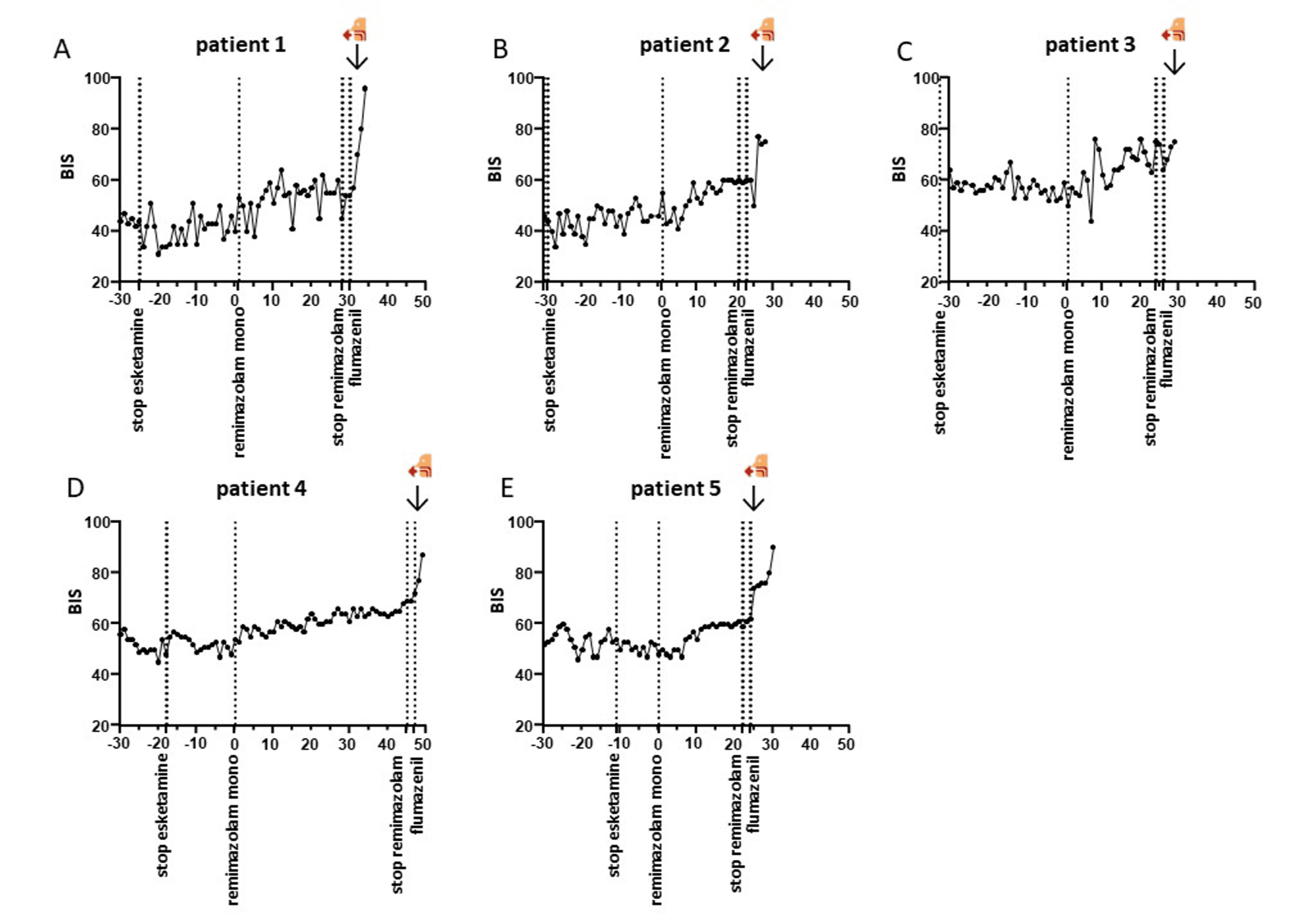
All patients remained hemodynamically stable throughout the procedure. No significant alterations in blood pressure were observed after switching to remimazolam as a mono-anesthetic. The time from flumazenil administration to extubation was two minutes in three patients and one minute in two. Additionally, no desaturation occurred in any of the patients. BIS values increased from 67.2 ± 9 to 83.3 ± 6.8 following the administration of flumazenil (Figure 1).

BIS-values-in-switching-and-antagonizing

No signs of excitation were observed in any of the patients, and no sudden changes in vital parameters occurred after antagonization. No patient movements or coughing were observed during switching or antagonization. Patients emerged calmly from general anesthesia and were quickly transferred to the recovery room. Overall, no adverse events occurred.

Clinical course in the recovery room and normal ward

The administration of opioids in the recovery room and normal ward was minimal, as presented in Table 2. In the recovery room, three patients received a dose of 5 mg piritramide, while no piritramide was administered to two patients. On the ward, one patient with an allergy to oxycodone received a single sublingual dose of 0.2 mg buprenorphine. Among the other four patients, one received a single 5 mg dose of oxycodone during the first 24 hours postoperatively, while the remaining three patients did not receive any additional opioids on the ward. No anti-emetic drugs were required during the entire 24-hour postoperative period.

Discussion

In this case series, a concept of “switch and antagonize” was used, which involved switching from a combination of remimazolam, propofol, and sevoflurane as hypnotic maintenance of anesthesia to remimazolam as the sole hypnotic agent near the end of the operation. Combined with flumazenil, this approach resulted in a rapid, predictable, and smooth recovery free from excitation or hemodynamic and respiratory disturbances. It demonstrates the feasibility of achieving controlled emergence from general anesthesia in humans through specific antidotes.

In 2023, Araki and Inoue described switching to remimazolam after anesthesia with sevoflurane, followed by flumazenil for the deep extubation of a patient with bronchial asthma [8]. While they administered flumazenil after deep extubation, Jeon et al. [9] reported an approach more similar to ours, involving the administration of flumazenil prior to extubation. They described converting from propofol to remimazolam with flumazenil reversal in adults with mental disabilities undergoing dental treatment one hour before the end of surgery [10]. To our knowledge, there are no other reports on “switch and antagonize.”

Several interesting questions remain. When should the switch occur? The timing of the switch should be long enough to sufficiently decrease the residual amounts of sevoflurane and/or propofol. However, a switch as close as possible to the end of surgery would be advantageous from a practical standpoint. Our data suggest that the one hour prior to the end of surgery, as used in the study by Jeon et al., may not be necessary. Even in the presence of long-acting opioids, a time point 20-30 minutes before the end of surgery might be sufficient. Nevertheless, this should be further investigated with larger sample sizes. It is also unclear whether an even shorter time interval could be feasible.

Certain operations, such as hip arthroplasty, allow for a better estimation of the remaining procedure time compared to others, such as intraoral procedures (Jeon et al. reported a relatively high standard deviation for the duration of remimazolam infusion at 64.7 ± 25 minutes) or laparoscopic surgery. This variability should be considered when planning the timing of the switch for specific procedures.

Another anesthetic regimen that could be interesting to investigate in larger randomized trials is propofol, remimazolam, and sevoflurane. At the end of the surgery, hypercapnic hyperventilation could be employed to rapidly eliminate sevoflurane and propofol, along with flumazenil, for the antagonism of remimazolam. This strategy has shown promise in several small studies [12-14].

How to switch? Araki and Inoue repeated the induction dose of remimazolam while switching. However, we do not believe this is necessary. Even after stopping propofol and/or sevoflurane, the plasma levels require some time to decrease, which might correspond to the time needed for the plasma levels of remimazolam to increase during initiation or escalation of remimazolam infusion. This aligns with the study by Jeon et al., who also did not administer a bolus of remimazolam during switching.

Araki and Inoue used a remimazolam dose of 0.8 mg/kg/h from the completion of the laparoscopic procedure until skin closure. This is comparable to our dosing regimen of 0.9 mg/kg/h after switching. Jeon et al. reported a remimazolam dose of 1-2 mg/kg/h, adjusted based on a processed EEG value after switching.

How much flumazenil is needed to antagonize remimazolam? Many studies on remimazolam and flumazenil, such as Toyota et al. [15], used a standard dose of 0.5 mg of flumazenil. Jeon et al. and our study also used the same dose of 0.5 mg of flumazenil. In contrast, Araki and Inoue used a dose of 0.9 mg of flumazenil. A titration approach, such as administering 0.2 mg of flumazenil followed by repeated doses of 0.1 mg every minute up to 1 mg until arousal [6], is also an option. However, as fast extubation without a prolonged “twilight zone” between full general anesthesia and complete wakefulness is preferred, starting with a higher standard dose might be more advantageous. Greater pharmacodynamic-pharmacokinetic insight into the relationship between remimazolam plasma levels and the required flumazenil dose could provide clinically important information in the future.

Some potentially negative clinical aspects of the remimazolam-flumazenil setting should be considered, such as extubation recall, PONV, and postoperative pain. Sato et al. concluded in a study of 163 patients that the incidence of extubation recall after remimazolam anesthesia with flumazenil antagonism during emergence did not significantly differ from that after propofol anesthesia [16]. Wei et al. reported that flumazenil antagonism of remimazolam might increase the incidence of PONV [7]. Although we did not specifically investigate PONV in our patients, the electronic patient records did not mention PONV in any of the five patients, and no antiemetic drugs were administered in the recovery room or on the ward. Interestingly, our extensive multimodal analgesic concept resulted in very low postoperative opioid use.

In rare cases (0.1-1%), the administration of flumazenil may lead to fear and palpitations. However, these side effects are transient and are most prominent when flumazenil is administered to awake patients rather than when used in asleep patients, as was the case in the current study design.

Due to the small sample size and retrospective study design, no strong conclusions can be drawn from our data. Furthermore, rather than focusing on individual variables, future studies should investigate whether our approach benefits overall recovery quality and the incidence of complications. More research involving larger groups of patients is warranted to verify whether the “switching and antagonizing” approach results in reduced and predictable extubation times and a more efficient workflow and reduces the risk of airway complications during and after extubation. This approach may be of particular interest to patients at increased risk of airway complications, such as those with difficult airways, bronchial hyperreactivity, or an elevated risk of aspiration.

Conclusions

Our case series demonstrates that the “switch and antagonize” concept is feasible and resulted in a rapid and smooth emergence and recovery in five patients, free from excitation or hemodynamic and respiratory disturbances. This was achieved by switching from combining remimazolam, propofol, and sevoflurane to remimazolam as the sole hypnotic agent, combined with flumazenil. Additionally, postoperative opioid use was minimal, and there was no need for antiemetic medication. Whether the “switch and antagonize” protocol could shorten the time to extubation and improve recovery predictability and efficiency should be investigated further. Moreover, cost-effectiveness and further evaluation and fine-tuning of this concept are needed, with particular emphasis on its application in patients with risk factors such as difficult airways or an increased risk of aspiration. It appears promising for future clinical use, especially for vulnerable patient groups, but larger (case-control) studies are essential to fully understand this approach’s potential.

References

  1. Popat M, Mitchell V, Dravid R, Patel A, Swampillai C, Higgs A: Difficult Airway Society Guidelines for the management of tracheal extubation. Anaesthesia. 2012, 67:318-40. 10.1111/j.1365-2044.2012.07075.x
  2. Benham-Hermetz J, Mitchell V: Safe tracheal extubation after general anaesthesia. BJA Educ. 2021, 21:446-54. 10.1016/j.bjae.2021.07.003
  3. He TY, Zhong RP, Zhong WB, Huang GM, Liu XC: Effect of remimazolam on intra-operative hypotension: systematic review and meta-analysis of randomised controlled trials. Eur J Anaesthesiol. 2024, 41:898-909. 10.1097/EJA.0000000000002057
  4. Yang C, Jiao J, Nie Y, Shao W, Zhang H, Huang S: Comparison of the bispectral indices of patients receiving remimazolam and propofol for general anesthesia: a randomized crossover trial. Anaesth Crit Care Pain Med. 2024, 43:101377. 10.1016/j.accpm.2024.101377
  5. Zhang S, Wang J, Ran R, Peng Y, Xiao Y: Efficacy and safety of remimazolam tosylate in hysteroscopy: a randomized, single-blind, parallel controlled trial. J Clin Pharm Ther. 2022, 47:55-60. 10.1111/jcpt.13525
  6. Lee J, Kim DH, Ju JW, Nam K, Cho YJ, Jeon Y, Lee S: Comparison of recovery profiles between total intravenous anaesthesia with propofol or remimazolam reversed with flumazenil in patients undergoing breast surgery: a randomised controlled trial. Eur J Anaesthesiol. 2024, 41:199-207. 10.1097/EJA.0000000000001951
  7. Wei Y, Zhu M, Man Y, Xiao H, Dong G, Shi X, Ji F: Clinical study of flumazenil antagonizing remimazolam on nausea and vomiting after gynecologic day surgery. Drug Des Devel Ther. 2024, 18:631-8. 10.2147/DDDT.S444313
  8. Araki H, Inoue S: Switching to remimazolam followed by flumazenil may be a promising combination for deep extubation. JA Clin Rep. 2023, 9:52. 10.1186/s40981-023-00643-7
  9. Jeon S, Kim J, Karm MH, Kim JT: Effect of converting from propofol to remimazolam with flumazenil reversal on recovery from anesthesia in outpatients with mental disabilities: a randomized controlled trial. BMC Anesthesiol. 2024, 24:151. 10.1186/s12871-024-02526-5
  10. Wu Q, Xu F, Wang J, Jiang M: Comparison of remimazolam-flumazenil versus propofol for recovery from general anesthesia: a systematic review and meta-analysis. J Clin Med. 2023, 12:7316. 10.3390/jcm12237316
  11. Koch R, Witkam R, van Eijk LT, Bruhn J: Triple anesthesia: combining sevoflurane, propofol, and remimazolam for general anesthesia in a case series. Cureus. 2024, 16:66737. 10.7759/cureus.66737
  12. Yaraghi A, Golparvar M, Talakoub R, Sateie H, Mehrabi A: Hypercapnic hyperventilation shortens emergence time from Propofol and Isoflurane anesthesia. J Res Pharm Pract. 2013, 2:24-8. 10.4103/2279-042X.114085
  13. Sakata DJ, Gopalakrishnan NA, Orr JA, White JL, Westenskow DR: Rapid recovery from sevoflurane and desflurane with hypercapnia and hyperventilation. Anesth Analg. 2007, 105:79-82. 10.1213/01.ane.0000265849.33203.60
  14. Sakata DJ, Gopalakrishnan NA, Orr JA, White JL, Westenskow DR: Hypercapnic hyperventilation shortens emergence time from isoflurane anesthesia. Anesth Analg. 2007, 104:587-91. 10.1213/01.ane.0000255074.96657.39
  15. Toyota Y, Kondo T, Oshita K, et al.: Remimazolam-based anesthesia with flumazenil allows faster emergence than propofol-based anesthesia in older patients undergoing spinal surgery: a randomized controlled trial. Medicine (Baltimore). 2023, 102:36081. 10.1097/MD.0000000000036081
  16. Sato T, Mimuro S, Kurita T, Kobayashi M, Doi M, Katoh T, Nakajima Y: Recall of extubation after remimazolam anesthesia with flumazenil antagonism during emergence: a retrospective clinical study. J Anesth. 2022, 36:688-92.

Red Blood Cell Transfusion Is Not a Recommended Treatment of Preoperative Anemia

Authors: Rettig, Thijs C.D. MD, PhD et al

Anesthesia & Analgesia January 2025.

To the Editor

We read with great interest the article of Choi et al regarding the better treatment of preoperative anemia: red blood cell (RBC) transfusion or intravenous (IV) iron.

We welcome studies examining the best treatment of preoperative anemia, as many studies have shown an unfavorable association with outcome. To address this topic the authors have performed a database study in patients with iron-deficiency anemia receiving treatment with only IV iron or only RBC transfusion before surgery. These patients were matched in a one-on-one fashion based on many variables, resulting in a large-sized cohort of 154,358 patients. Compared to RBC transfusion, IV iron was associated with a 37% lower risk of mortality and a 24% lower risk of combined morbidity after surgery. However, there are several concerns we would like to address. Our first and main concern is that preoperative treatment with IV iron was compared to RBC transfusion, a well-known risk factor for worse postoperative outcomes that has been repeatedly established. For this reason, patient blood management (PBM) guidelines recommend against RBC transfusion to treat preoperative anemia, except in case of a very low hemoglobin level (<7 g/dL) and insufficient time for alternative treatment due to the urgency of surgery. By comparing IV iron with RBC transfusion, we now know that IV iron is superior to a treatment we should avoid as much as possible, but we do not know whether it truly improves patient outcomes.

In our opinion, the actual research question should be whether IV iron is superior to no treatment of preoperative anemia. Currently, PBM guidelines recommend IV iron as treatment of preoperative anemia, but apart from higher hemoglobin values and RBC less transfusion, convincing evidence that IV iron improves other patient outcomes (eg, less mortality or morbidity) is still lacking.

Our second concern is the high number of patients treated with preoperative RBC transfusion. Despite the well-known association with adverse postoperative outcomes, patients with iron-deficiency anemia were more likely treated with RBC transfusion (n = 127,415) than with IV iron (n = 114,071). Some even to hemoglobin levels >12 g/dL at the day of surgery (approximately 7% according to Table 1). We can only guess why RBC transfusion was used to treat preoperative anemia, as information on the hemoglobin levels at the moment of RBC transfusion is not reported. And third, we wonder which surgical procedures were studied. In Supplementary Table 4, a list of all surgical procedures is reported. Approximately 80% of patients underwent a “vascular introduction and injection procedure” or an “endoscopy procedure on the esophagus”, both nonsurgical procedures. The Current Procedural Terminology (CPT) codes for “vascular introduction and injection procedure,” includes procedures such as “venipuncture and transfusion procedure” and “insertion of central venous access device.” Based on the above, it seems that patients not fulfilling the study inclusion criteria were analyzed. Could it be that nonsurgical patients, such as patients with upper gastrointestinal bleeding, were included? This would, at least in part, explain some of our questions.